I was intrigued by news of a recent Science Communications paper by Kreider et al. entitled “Fire suppression makes wildfires more severe and accentuates impacts of climate change and fuel accumulation” (https://www.nature.com/articles/s41467-024-46702-0). By suppressing fires, they note that only relatively large fires are left to burn. That “suppression bias” is a necessary statistical consequence of suppressing fire. Simply put, we create a larger stack of tiny fires by pulling some away from the larger-fire size categories.
Even though the average fire size decreases with suppression because we move larger fires into a smaller-fire pot, the counter-intuitive part of their paper is that the average severity of the land area that burns will be greater because fires that are allowed to burn are, on average, relatively severe ones. Andrew Larson expressed worry that the loss of low-severity fire effects will act to the detriment of plants and animals adapted to low-severity fire, but there are two reasons why I’m not so worried about that.
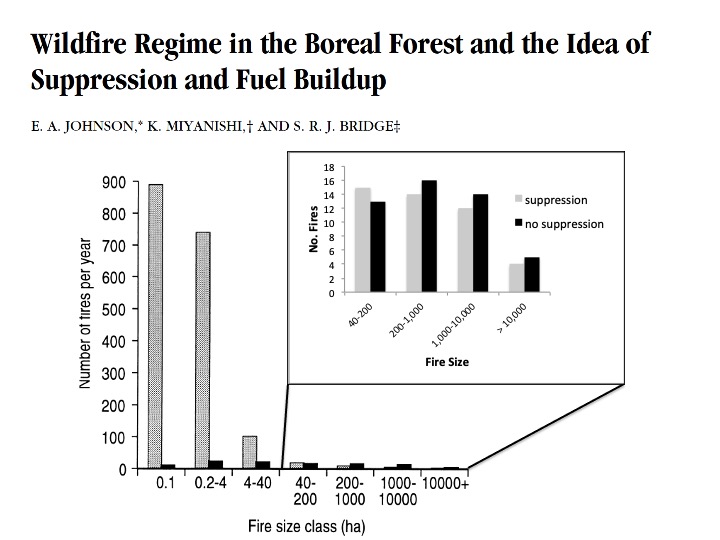
First, the loss in area burned at low severity is trivial because most suppressed fires are going to be small anyway, as Johnson et al. demonstrated in a 2001 article in Conservation Biology. Their eye-opening data demonstrate that, for fires larger than 40ha, the distribution of fire sizes from the suppressed area was no different than the distribution of fire sizes from the historically unsuppressed area (see data to the left).
Basically, fire suppression keeps tiny fires from becoming slightly less tiny—it does not keep tiny fires from becoming large fires. Large, severe fires occur no matter what we do because they are weather driven, not fuels driven. Therefore, when Andrew says he’s worried that we might be “…exposing plants and animals to relatively less low-severity fire and relatively more high-severity fire,” that’s not worrisome because there’s not much change in the absolute amounts of low- and high-severity fire.
The second reason why the loss of low-severity fire has probably had little ecological consequence is that, unless I’m wrong, there are no plants or animals that have evolved to depend on low-severity fire. Can anyone suggest a plant or animal species that is totally or nearly restricted to conditions created by low-severity fire (a key criterion associated with adaptation to any environment is its restriction in distribution to that environment)? I’d love to have examples of that if they exist.
 Fire Ecology
Leave a comment